

Last weekend, I rewatched ‘A Beautiful Mind.’
In the movie, the famous scene that everyone remembers comes early.
Nash and four friends are drinking near Princeton.When a group of women walks in — one blonde, several brunettes — they immediately start working out who has dibs on the blonde. Someone brings up Adam Smith. Go after what you want, let competition do the rest, everybody ends up better off.

Yet, John Nash goes quiet.
He’s seen what happens if they all take that advice. They’ll crowd the blonde, block each other, and get nowhere. Then they’ll turn to her friends, who by then know exactly what they are — second choice. Nobody goes home with anyone.
Every man playing his best hand, and the table comes up empty.
Economists have spent years pointing out that this isn’t really a Nash equilibrium.
Fine. What sticks is the face — a man in a bar watching the world quietly rearrange into a shape nobody else at the table can see.
A few days later I was reading about American health insurance, and there it was again.
The cliff
There’s an invisible cliff in America. It sits at 400 percent of the federal poverty line — about $63,000 a year for a single person.
Stand to the left of that line and the government helps pay your insurance premium. Step an inch right and it doesn’t. One extra dollar of income, and you owe thousands more.
Economists call it the subsidy cliff. That sounds like a metaphor. It isn’t.
In 2021, Congress laid a temporary ramp across it. Premiums were capped at 8.5 percent of income for anyone who needed help, no matter what they earned. Like most temporary things in Washington, it got extended twice. On December 31, 2025, it ran out.
Here’s what that means, using an example from the Bipartisan Policy Center.
A couple in their sixties making $85,000 sits at 402 percent of the poverty line. This year, they could face more than $22,000 in premiums — a quarter of their income. At 398 percent instead of 402, the bill would have been 8.5 percent.
Four percentage points of income. Everything else identical.
This reads like a story about American politics. It’s really a story about game theory.
The people selling lemons
In 1970, an economist named George Akerlof wrote a paper about used cars. Three journals rejected it. Thirty-one years later it won him a Nobel.
His argument:
whoever sells a used car knows if it’s a good one or a lemon. The buyer doesn’t. So the buyer offers an average price — and the owner of the good car says not for that, and drives off. Now the average quality of what’s left has dropped, so the price drops, so the next-best owners leave too. Round and round until there’s no market.
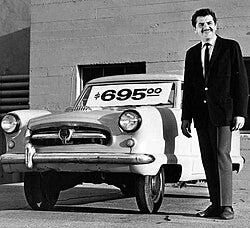
Swap in health insurance and the lemon is a sick person. The good car is a healthy one. And what’s being sold isn’t a car. It’s the person.
Charge everyone the average risk, and the healthy start doing math.
I see a doctor once a year. This is money down a hole.
They leave. The remaining pool gets sicker. Premiums climb. The next-healthiest person picks up the calculator.
Economists call this the death spiral.
Notice there’s no villain in it. The woman who cancels her plan made a reasonable call about her own budget. The insurer is trying not to lose money. Every decision holds up on its own — and together they take the market down.
That's the thing John Nash proved you can't wish away. Whenever people's choices depend on each other, there's a point where nobody has any reason to move alone. Everyone is doing the best they can, given what everyone else is doing. Nothing says that point has to be good for anybody.
Three locks
The people who wrote the Affordable Care Act in 2010 knew all this. So what they built wasn’t really an insurance program. It was a set of rules for a game.
The law told insurers they couldn’t turn anyone away for a pre-existing condition — which on its own is an invitation to the spiral. Why buy coverage before you need it? So they bolted three locks onto it.
The mandate. No coverage, a fine. It keeps healthy people from getting up from the table.
The subsidies. A fine alone doesn’t work. If you can’t afford a premium, a penalty is just a threat with no door attached. So they cut the price until staying was the better deal.
The enrollment window. You can only sign up a few weeks a year, which kills the strategy of enrolling the morning after a diagnosis.
Punishment, reward, timing. Not one of them tries to change what people believe. They change what the calculator says.
In 2017, the first lock came off — a tax change cut the mandate penalty to zero. On January 1 of this year, the second one loosened.
What happened next
The average monthly premium people actually pay, after tax credits, went from $113 to $178. Fifty-eight percent, according to the Kaiser Family Foundation.
But the average isn’t the story. Who left first is.
People earning between 400 and 500 percent of the poverty line — the ones standing right at the edge — were 3 percent of last year’s enrollees. They account for 27 percent of the drop. Enrollment in that band fell 44 percent, more than 321,000 people.
Picture them. They earn too much to qualify for help and not enough to absorb a $20,000 bill.
Contractors, freelancers, people at small firms, couples a few years short of Medicare. And they’re healthy enough, right now, that leaving is an option.
Exactly the sequence Akerlof described, fifty-five years later. The good cars leave the lot first.
None of which settles the politics. The Congressional Budget Office finds that making the subsidies permanent raises coverage and widens the deficit; letting them lapse saves money and leaves more people uninsured. There’s a real argument, too, that heavy subsidies let insurers stop worrying about price. Nobody here gets a free option.
But one thing isn’t up for debate.
Change the rules and behavior changes. Every time.
The board
Near the end of the movie, Nash doesn’t get better by making the hallucinations stop. They’re still standing there in the final scenes — the roommate, the little girl, the man from the Pentagon. He can see them. He just stops turning his head.
What changes isn’t the content of his mind. It’s what he does about it.
That’s the whole lesson, and the insurance story keeps repeating it. We’d rather explain these things as failures of character — the uninsured are irresponsible, the insurers are greedy. Game theory offers something colder: everyone can be decent, everyone can be rational, and if the board is badly built the outcome is still bad.
Flip that over and it turns almost hopeful. You can change the outcome without changing the people.
Shouting don’t fall at someone on a cliff edge is not the same as building a railing. Whether that railing held, what it cost, who should have paid for it — the arguing hasn’t stopped.
But nobody argues with gravity. Take the railing away, and people fall.
![속임수에 빠진 청년[이은화의 미술시간]〈225〉|동아일보](https://substackcdn.com/image/fetch/$s_!4kvV!,f_auto,q_auto:good,fl_progressive:steep/https%3A%2F%2Fsubstack-post-media.s3.amazonaws.com%2Fpublic%2Fimages%2Fe82ec819-92ea-4e0e-a507-b21515fa0d46_640x463.jpeg "속임수에 빠진 청년[이은화의 미술시간]〈225〉|동아일보")
"In the great chess-board of human society, every single piece has a principle of motion of its own." — Adam Smith, The Theory of Moral Sentiments (1759)

The men in the bar thought they were joking about Adam Smith. They had the wrong book. Nobody had to be a villain for any of this to happen. We keep calling it selfishness, because selfishness can be scolded and arithmetic cannot. Everyone who dropped their coverage this winter did the sums correctly. Which leaves exactly one thing anyone can change. Not the pieces. The board.