

Alive enough to run
It all begin with the awakening of Jim in the hospital, with an IV needle dragging in his arm.
Jim finds nobody is around him to help him pull off the needle. So, he yanks it out by his own, pulls some clothes on, wanders into the corridor, and looks for any sign of help, from anyone. It didn’t take long enough for him to realize that things are only getting worse.
When Jim steps out into the streets of London, it is dead empty. He can see cars left rotting in the middle of the road and old newsprint skittering across Westminster Bridge all by itself.
He shouts into the emptiness—blind panic giving way to the silence, answered only by his own fading echo.
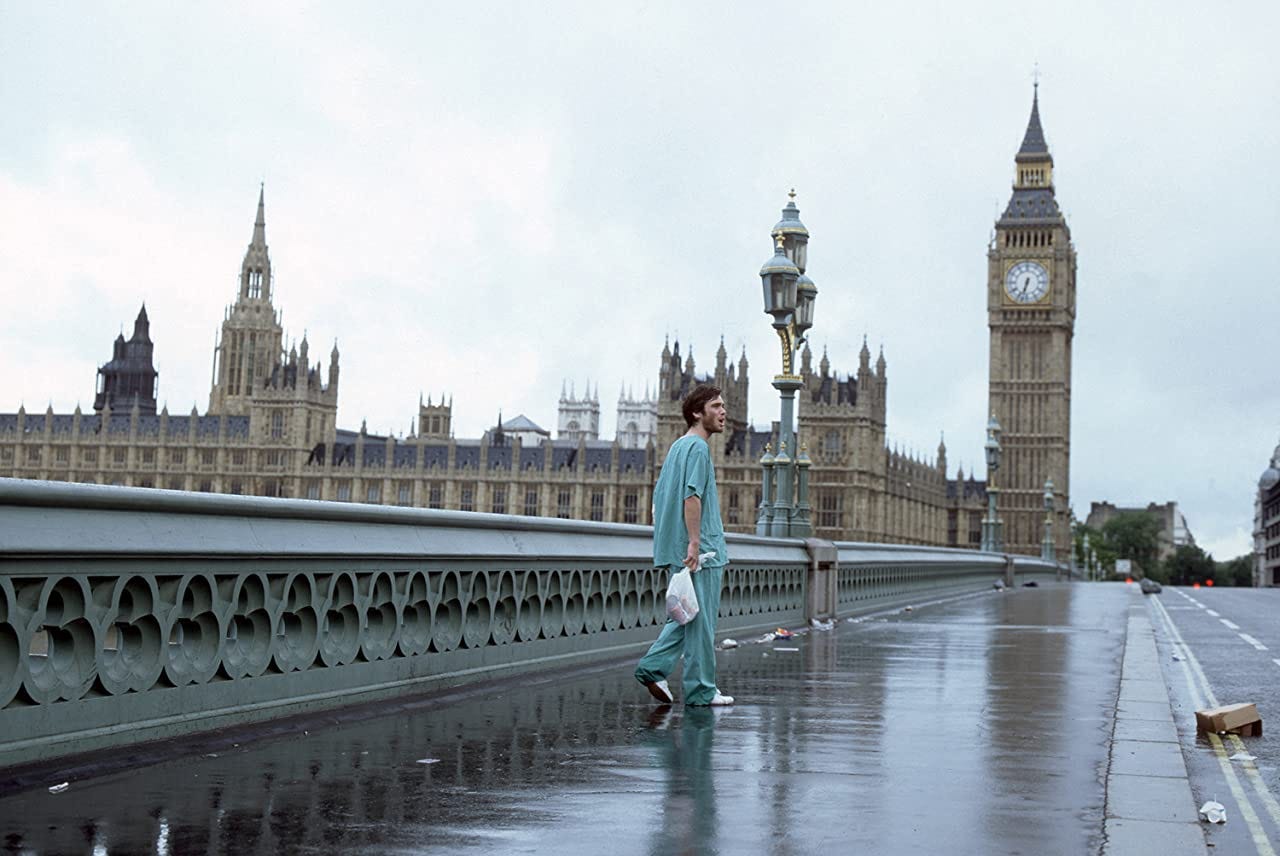
It’s the most memorizable scene in 28 Days Later, mostly because the film being unkind, explaining nothing to the audience. For the first few minutes, the audience faces London not as a battlefield, but as a place where eight million people simply vanished.
Then the Infected finally arrive, shattering the silence. That’s when the audience realizes Boyle and Garland weren’t playing with voodoo or resurrection. The monsters are just patients - filled flesh and blood just like human. They bleed, they pant, they starve, and worse, they can sprint.
And yet, in the real world, a monster built like that scores a flat zero on the only test that turns an outbreak into an apocalypse.
Running on Empty
Zero is also roughly what our own bodies keep in reserve.
We tend to think the cost of movement is free.
Standing up, walking across a hall, climbing the stairs—we take it all for granted, never once seeing it as a metabolic debt.
In reality, every single motion has to be funded. Our muscles burn through ATP1, and the body stores practically none of it - maybe three or four seconds' worth, manufactured on the fly from sugar and fat with oxygen hauled in by the blood. There is no surplus. You pay as you go.
Yet, this is just the first line of the invoice billed onto our body
Repetitive movements will tear tissues apart eventually. Repairing it requires protein synthesis, which demands fresh amino acids and another withdrawal of energy. Even staying warm carries an ongoing cost.: maintaining our body temperature near 37°C isn’t passive perk of being human, it’s a metabolic tax paid every single second.
A living body is able to pay the price without thinking. Yet, a corpse can’t: death doesn’t write off the debt.
As soon as the circulation halts, autolysis2 will take over our body. Lysosomal enzymes will breach cell membranes, and tissues will start to digest itself. Rigor Mortis is pure counter-intuition: ATP doesn’t trigger the contraction. ATP allows actin and myosin to detach, the cross-bridge is locked in place and muscle is simple trapped due when our metabolic cash flow dries out.
The stiffness will fade away eventually but nothing will be repaired. The architectures is simply rotting down like a wooden house collapsing under its own frame.
And beneath the collapsed frame, the law of biology doesn’t quite follow the movie script.
There is no circulation to provide oxygen, no metabolism to throw off the heat, no protein synthesis repair the damage. The paycheck stopped coming, yet the account is still being drained.
What remains is not a monster, but a decaying mass of tissue. But a cold, falling tissue mass destined to rot - leaving no budget to move around, or sprint.
Buying the Sprint
Yet, the film 28 Days Later demanded speed.
So, the solution was simple: the monsters in the film are not dead.
They are indeed infected patients - whose blood still circulate, whose oxygen reaches the muscle fibers, whose body temperature is maintained, and whose tissue damage is being repaired.
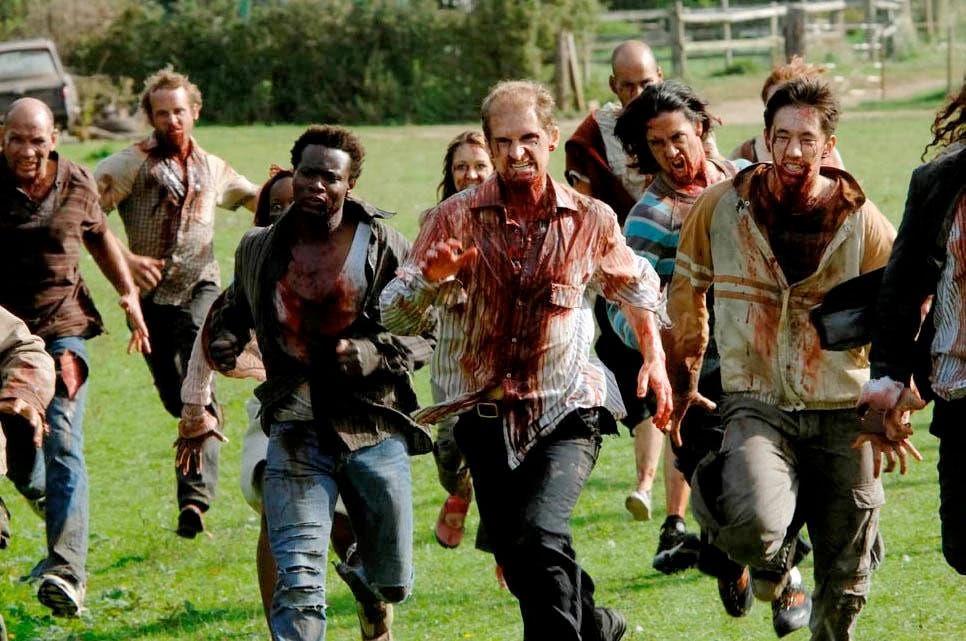
Running stops being a cinematic trick and becomes a metabolic expense: the infected have to eat.
And it is clear that the film is aware of this biological equation. In a fortified country estate, Major West keeps an Infected solider chained in the courtyard - as a live countdown timer to see how long it takes to starve the monster to die.
Classical zombies get to be dead because dead bodies don’t maintain themselves. They also can’t do much. 28 Days Later made the opposite trade — it wanted speed, so it kept the machinery of life, and by the end of the movie some of the Infected are too depleted to get off the ground. The machinery of life arrives with an invoice.
A Vector Without a Destination
The metabolic invoice is only half of what the film’s virus pays for.
The other half is direction. Keeping a host alive allows them to run, but something still has to steer the legs - the infected don’t just wander, they hunt. In epidemiology, an active agent that carries a pathogen straight to its next victim is called a vector; the film simply strips its hosts of all conscious agency and turns them into precisely that.
Nature already knows how to hijack a body.
Ophiocordyceps marches ants out of their colonies to scatter spores
Toxoplasma nudges rats toward cat scent.
Yet, considering the movie’s context, rabies remains the closest real-world blueprint for the film—neurotropic, violently disruptive, salivating, and almost invariably lethal. It possesses every terrifying trait the horror genre demands, weaponizing the nervous system to force a bite.
However, rabies to fail a single test that determines an epidemic: finding the next host.
Of course, there has been some transmission due to tragic medical anomalies like organ transplants, there are no known human-to-human transmission of rabies.
In other words, rabies pays the entire metabolic cost to gain aggression but collects zero evolutionary return. A pathogen can turn a host into a furious predator, but that doesn’t make an outbreak sustainable.
In reality, human beings are not vectors. We are dead ends.
Even measles runs out of people
Turning an infection into an outbreak requires clearing two very different hurdles.
Rabies fails at the first: it never reliably passes from one human to another. clearing the first hurdle only exposes the second: finding someone left to infect. And the most aggressive transmitter nature ever built fails right there.
Measles pairs terrifying transmissibility with lifetime immunity. It burns through an unprotected population so fast that it incinerates its own fuel supply, leaving nothing behind until a new generation is born. It is the most efficient spender of susceptible hosts on Earth, and that very efficiency is what routinely bankrupts it. It doesn’t run out of transmission; it simply runs out of people.
The virus in 28 Days Later has to clear both links. It clears neither.
The World the Virus Actually Wanted
Empty ground is what the apocalypse manufactures.
In nearly every version of the story, civilization collapses and people scatter. Small groups vanish into farms, forests, and shuttered houses. Roads empty out. Airports close. The city becomes the first thing people flee.
For a fast-burning pathogen, this cinematic landscape is an absolute catastrophe.
Travel between communities halts. New births become scarce. An outbreak tears through whoever is trapped inside the room and then starves out in the silence. The fictional apocalypse dismantles the exact conditions such a pathogen needs to survive.
The real world spent an entire century building those conditions on purpose. We concentrated populations, connected them with cheap flights, and ensured a carrier could cross an ocean well before a fever ever broke.
There is a second inversion sitting right beside it. A bite reads as an efficient way to spread a disease only because cinema conditioned us to understand violence instantly. Epidemiologically, it is hopelessly clumsy. A respiratory pathogen needs no teeth, no sprinting, and no physical struggle; it needs only an enclosed room, a handful of strangers, and shared air.
The host does not need to be violent. It barely needs to be awake.
The best host is the one who feels well
Silence is an overwhelming advantage on a pathogen’s balance sheet.
A visibly sick monster announces its danger from down the street, making it easy to isolate. Successful pathogens do the opposite. They spread while the host feels fine—letting people carry on commuting, working, and breathing in the same room.
Severity is an entry on the pathogen’s loss column. A disease that drops its host instantly strands itself; one that keeps the host functional keeps circulating. Even Ebola, which turns deadly and infectious at once, routinely burned itself out—until 2014, when roads and cities carried it across borders. As director Danny Boyle noted, we haven’t all died of Ebola because it is simply too lethal to buy the time it needs
The virus had to get cheaper
Frightening is expensive, and the franchise eventually had to pay for it.
The original 28 Days Later understood that living muscle needs continuous fuel, and its sequel took that physiology seriously enough to let the Infected starve. By the time 28 Weeks Later begins its reconstruction, Britain has been declared infection-free—the last host presumed dead weeks ago. The pathogen hadn’t been defeated by human wit; it had simply gone broke.
This left the third installment, 28 Years Later, with a metabolic deficit of its own. A virus that exhausts its host in a month cannot sustain an apocalypse across decades. The sheer kinetic energy the original Infected burned could not continue indefinitely without collapse. To survive nearly three decades on screen, the pathogen had to adapt: the Infected learned to forage and feed. After twenty-eight years, even the end of the world requires a grocery bill.
Twenty-eight is not a date
The accounting is written right into the titles.
Twenty-eight days: hosts spending metabolic capital faster than any human body can fund.
Twenty-eight weeks: an epidemiological bank run, draining the population until transmission collapses.
Twenty-eight years: a pathogen finally forced to live within its means.
Every living system depends on an uninterrupted supply line. Muscle demands ATP. Cellular warmth carries a cost. Viruses require hosts, and epidemics require an endless surplus of them.
28 Days Later was never really about the monsters. It was an autopsy of borrowed time. The defining image of the film is not a sprinting terror, but a chained soldier in a courtyard—starving strictly on schedule, while a commanding officer watches the clock to see what running out looks like.

"吾生也有涯,而知也無涯。以有涯隨無涯,殆已。" — 莊子, 『莊子』「養生主」 (c. 4th c. BC)

My life has a limit; knowing has none. To chase the limitless with the limited is to be finished. -  Zhuangzi, Zhuangzi, "The Secret of Caring for Life"

Specify a workable monster and the list writes itself. It keeps the host alive,
because a corpse cannot chase anyone. It leaves him upright, employed, and
asymptomatic, because a man who cannot get out of bed meets nobody. And it
travels where we have spent a century arranging for things to travel — trains,
offices, classrooms, rooms with the windows shut.

Not one item on that list is a monster. Every item is a concession. Nothing
attacked Millet's man either. Nothing needed to.

Jim woke in a hospital and walked out of it. In January 2025 a man in Ohio was
admitted to one and did not. His kidney came from a donor who had been
scratched by a skunk, and rabies has reached a second person in the United
States exactly four times since 1978.

It could not cross a room. It travelled in a cooler.

It never needed rage, or teeth, or the dead.ATP (adenosine triphosphate) — the molecule cells spend to do work. Held in tiny quantities and remade continuously from glucose, fat and oxygen.
Autolysis — self-digestion. After circulation stops, enzymes normally confined inside cellular compartments escape as membranes fail and begin breaking down the cell's own structures. It precedes bacterial decomposition